
One of the most frequent questions we address in the showroom is not about fabric patterns or pleat styles. It is about length. Specifically, homeowners ask if their curtains should actually touch the floor.
The short answer is yes. In modern interior design, floor-length curtains are the standard for a polished and finished look.
However, the “short answer” rarely accounts for the nuances of daily life, uneven flooring, or fabric physics. The difference between a room that feels professionally designed and one that feels slightly “off” often comes down to a single inch of fabric at the bottom of your window.
This guide will break down the exact length options, the material science behind fabric movement, and why “high-water” curtains are the ultimate design foul.
The Golden Rule: Why Length Matters
Visually, your curtains act as the vertical pillars of a room. When they stop short of the floor, they visually cut the wall in half. This makes your ceiling feel lower and the room appear smaller.
From a functional standpoint, curtains that reach the floor offer superior insulation. By creating a seal or a near-seal against the floor, they prevent cold drafts from escaping under the hem. This is crucial for energy efficiency in colder months.
The Three Standards of Curtain Length
In professional design, we generally avoid “short” curtains (those that end at the window sill) unless there is a radiator or deep furniture obstruction. For a polished, high-end look, you are choosing between three floor-length options.
1. The Kiss (Touching)
This is the gold standard for custom tailoring. The curtain panel touches the floor barely—or “kisses” it. It requires incredibly precise measurement and installation.
-
The Vibe: Tailored, intentional, and clean. It lengthens the visual line of the wall without creating clutter on the floor.
-
Best For: Master bedrooms, formal living rooms, and heavy traffic areas where you want polish without the tripping hazard.
-
The Trade-off: There is zero margin for error. If your floors are uneven (which is true in 90% of homes), the curtain may kiss the floor on the left and hover on the right. Professional installers often adjust the hooks on the track to micro-correct for this.
2. The Float (Hovering)
Here, the panels hang less than an inch (usually about ½ inch) off the floor. The curtain hangs straight and never touches the ground.
-
The Vibe: crisp, modern, and highly functional.
-
Best For: High-traffic zones, homes with pets (less hair accumulation), or rooms with robot vacuums. It is also the safest choice for drapes and curtains made of heavy, stiff fabrics that don’t fold softly at the bottom.
-
The Trade-off: If the gap is too wide (more than an inch), it looks like “high water” pants—an unfortunate mistake that makes the ceiling feel lower.
3. The Puddle
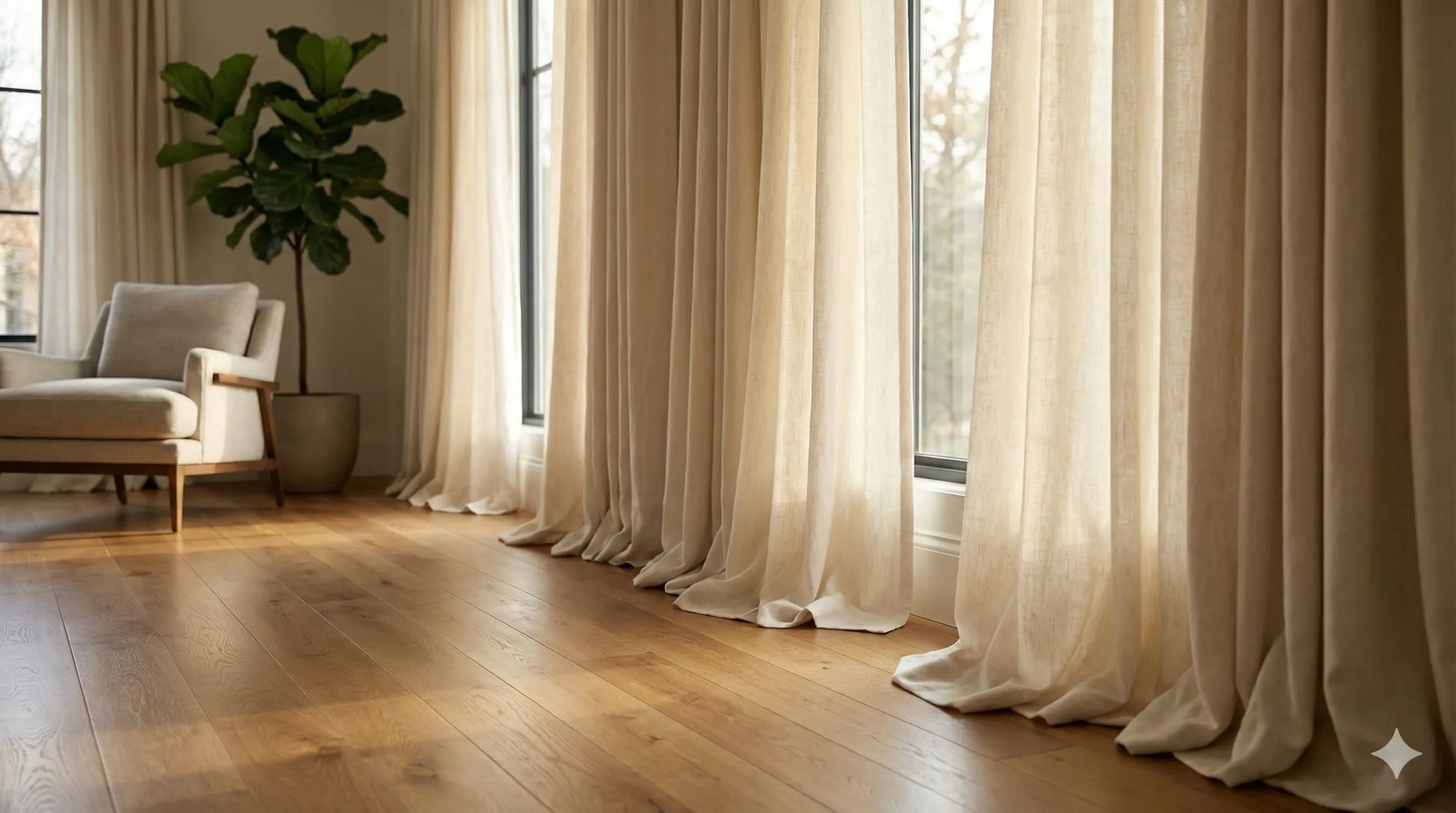
This involves adding extra length (anywhere from 2 to 6 inches) so the fabric gathers or “puddles” on the floor.
-
The Vibe: Romantic, opulent, and relaxed. It suggests luxury because it implies the fabric is abundant.
-
Best For: Low-traffic formal dining rooms, nurseries, or historic homes with extremely uneven floors (the extra fabric disguises the slope).
-
The Trade-off: High maintenance. You must “dress” the curtains every time you vacuum or open them. It is a dust magnet and a favorite bed for cats.
The Science of Fabric: Why “Touching” Changes Over Time
Here is an insight most off-the-shelf retailers won’t tell you: Fabric is not static.
When deciding on length, you must consider the material composition. Natural fibers, particularly linen and cotton, are hygroscopic. They absorb and release moisture from the air.
-
High Humidity: Linen fibers swell and can shorten, causing a curtain that was perfectly “kissing” the floor to suddenly float an inch too high.
-
Low Humidity: In dry winter months, those same fibers relax and lengthen, potentially turning a “kiss” into a “drag.”
If you are committed to natural fibers in a climate with seasonal swings, we often recommend a “breaking” length (about 1 inch of puddle). This provides enough slack to accommodate the fabric’s movement without it looking like a measurement error.
Alternatively, synthetic blends or stabilized fabrics offer dimensionally stable options for homeowners who demand a precise architectural line year-round.
Design Trade-offs: Aesthetics vs. Reality
Before finalizing your measurements, consider these real-world friction points.
Cleanliness and Allergens
If you suffer from allergies, avoid the puddle. Fabric on the floor acts as a Swiffer, trapping dust, pet dander, and pollen. A “floating” hem allows for easy sweeping and air circulation. For spaces where hygiene is paramount, such as kitchens or bathrooms, you might consider swapping soft treatments for shades, which sit neatly inside the frame and stay far away from floor-level dust.
Floor Unevenness
In older renovations, it is common for the floor to slope significantly from one side of a sliding door to the other.
-
The Fix: If you choose a straight hem (The Float), the slope will be obvious because the gap of light at the bottom will act like a level. In these cases, a slight puddle is the smartest choice—it masks the imperfection of the architecture.
Heating and Cooling
If you have baseboard heaters, floor-length curtains are a fire hazard and an energy efficiency nightmare (blocking the heat from entering the room). In this scenario, function trumps style. You should opt for Roman shades or blinds that stop at the sill.
The “High and Wide” Installation Rule
The question of “touching the floor” is inextricably linked to where you hang the rod. A common amateur mistake is mounting the rod directly on the window frame.
To maximize the elegance of floor-length curtains:
-
Go High: Mount the hardware 4-6 inches above the window frame, or even directly under the ceiling cornice. This draws the eye up, making standard ceilings feel vaulted.
-
Go Wide: Extend the rod 8-12 inches past the window on either side. This allows the “stack” (the bunched open curtain) to rest against the wall, rather than blocking the glass.
This technique requires longer panels, which increases the fabric yardage and price, but the result is a window that looks 20% larger and a room that feels significantly more expensive.
Summary Checklist: Which Length is Right for You?
| Style | Gap/Puddle | Best Application | Maintenance Level |
| The Float | ~½ inch gap | High traffic, sliding doors, robot vacuums | Low |
| The Kiss | 0 inches | Master suites, tailored living rooms | Medium (requires precise hanging) |
| The Puddle | +2 to +6 inches | Formal dining, uneven floors, velvet fabrics | High (requires styling) |